How to Write a Job Description That Stands Out in a Competitive Market
July 30, 2026

In a competitive job market, attracting the right candidates starts long before the first interview — it starts with the job description. For many job seekers, a posting is the very first interaction they have with your company, and the impression it creates shapes whether a strong candidate decides to apply, move on, or not even stop scrolling in the first place.
That first impression matters more than most hiring teams realize. A job description that’s unclear, overloaded with requirements, or written in generic language that could apply to any company in any industry can quietly drive away exactly the kind of candidates you’re hoping to attract — often without anyone on your team knowing it’s happening.
We also understand that writing a thoughtful job description isn’t always easy when you’re managing a full plate. Most hiring managers are juggling sourcing, interviews, internal stakeholders, and the day-to-day demands of running a business — and the job description can end up being the last thing that gets careful attention before a role goes live.
That’s exactly why we put this together. At Murray Resources, we work with companies across industries every day and review job descriptions as a regular part of how we help organizations attract and hire top talent. What we’ve found consistently is that the job descriptions that perform best aren’t the longest or the most detailed — they’re the most focused, the most honest, and the clearest about what the role actually is and what a great candidate looks like. A few thoughtful adjustments can make a meaningful difference in the quality of candidates who come through the door.
Key Takeaways
- Your job post is your first impression on the candidates you most want to hire. A focused, well-written posting signals strong leadership, clear expectations, and a company worth working for — before a single conversation has taken place.
- Overloaded job posts drive away top candidates. Skilled professionals are selective, and a long list of requirements that feels unrealistic or unfocused is often enough to make a strong candidate move on.
- The best job posts are precise, honest, and candidate-focused. They communicate clearly what the role requires, what success looks like, and why the opportunity is worth a strong candidate’s time and consideration.
Why Strong Candidates Are Selective — And What That Means for Your Job Description
Something worth keeping in mind as you think about your job description: the candidates you most want to hire are also the ones with the most options. Skilled industry professionals who are actively exploring new opportunities aren’t applying to everything that looks remotely relevant — they’re being intentional about where they invest their time and energy, and they’re making quick judgments about whether an opportunity is worth pursuing based largely on how the job description reads.
Many of them are already hearing about roles through former colleagues, networking events, and recruiters before they even see a posting. By the time they land on your job description, they’re often looking for confirmation that the opportunity is as strong as they’ve heard — and the way it’s written either builds that confidence or quietly erodes it.
Here’s what job seekers are genuinely asking themselves when they read a job description:
- Does this role actually match my work experience and skills — or does it feel like a wish list that no single person could realistically fulfill?
- Is this company clear about what they need — or does this job description suggest the role isn’t fully thought through yet?
- Does this opportunity align with my career goals — or is it another generic posting that could have come from any organization in any industry?
When something in the job description raises doubt, strong candidates tend to move on — not because they aren’t interested in the role, but because the posting didn’t give them a compelling enough reason to stay. The role itself might have been a genuinely great fit. The job description just didn’t communicate that clearly enough to stand out.
💡 Tip: From our side of the recruiting process, we’ve seen strong candidates pass on excellent opportunities simply because the job description didn’t reflect the quality of the role or the company behind it. Think of your job description as your pitch to the market — it deserves the same care and intention as any other part of your hiring process. For more guidance on building a process that consistently attracts strong candidates, visit our employer resources.
The Most Common Job Description Mistakes — And How to Spot Them

Most job description challenges come down to a handful of patterns that are genuinely easy to fall into — especially when you’re moving quickly or working from an older template. Here’s what to watch for:
❌ Including every possible qualification instead of the ones that truly matter.
This one usually comes from a good place — the goal is to be thorough and find the best possible person for the role. But when a job description lists every skill, credential, and experience that could conceivably be relevant, it can read more like an exhaustive wish list than a clear picture of what the job actually requires. Strong candidates tend to do the math quickly — and when the list is long enough, even highly qualified people will talk themselves out of applying, assuming they’re not the right fit when they absolutely could be.
❌ Presenting required and preferred qualifications as if they carry the same weight.
When everything on the list looks equally important, candidates have no way to determine what’s truly essential and what’s simply a nice bonus. A candidate who checks 80% of your genuine requirements but is missing a few nice-to-haves may never apply — simply because the job description didn’t make it clear that those extras were optional. Being explicit about which qualifications are essential functions of the role versus which skills can be gained on the job makes a real difference in who feels confident enough to apply.
❌ Leading with duties instead of the opportunity.
A job description that focuses entirely on duties and responsibilities tells candidates what they’ll be doing — but it doesn’t tell them why the role matters, what success looks like, or why a talented person should choose this opportunity over others they’re considering. That context is what makes a job description genuinely compelling, and it’s one of the most commonly missed elements in postings we see.
❌ Relying on language that blends in rather than stands out.
Phrases like “fast-paced environment,” “team player,” and “competitive salary” have appeared on so many job descriptions for so long that candidates read right past them. They don’t communicate anything specific about your company, your culture, or what makes this opportunity worth pursuing — and in a competitive job market, generic language is a missed opportunity to say something that actually resonates.
❌ Missing the legal compliance piece before the post goes live.
A job description is both a marketing tool and a legal document, and it’s worth treating it as both. Making sure your posting reflects equal opportunity employment practices, includes appropriate language around the Americans with Disabilities Act, and doesn’t inadvertently create barriers for protected groups is an important step that can get overlooked when the focus is on getting the role filled quickly. A quick review before posting — whether internally or with a recruiting partner — goes a long way toward protecting your organization and presenting your company professionally to candidates
What an Effective Job Description Actually Looks Like

The good news is that writing a strong job description doesn’t require starting from scratch or overhauling your entire hiring process. It comes down to a few intentional choices that, once they become part of your routine, make the whole process easier — and the results noticeably better.
🔹 Start with a clear, accurate job title.
The job title is often the very first thing a candidate sees — on job boards, in search results, and when former colleagues or contacts share an opportunity. A title that’s clear, accurate, and searchable is one of the simplest ways to make sure your job description reaches the right people before they’ve even read a word of it.
From there, open with a compelling description of the role and its purpose rather than a generic company overview. Give candidates an immediate sense of:
- What this person will actually do day to day
- What the essential functions of the role are
- Why this position exists and what it’s meant to accomplish within the organization
That kind of clarity up front signals that the company knows what it’s looking for — and gives candidates what they need to quickly determine whether it’s worth reading further.
🔹 Be clear about what’s required and what’s a bonus.
One of the most practical things you can do to improve your job description is to distinguish clearly between must-have qualifications and nice-to-haves. It’s a small change that can meaningfully expand the pool of strong candidates who feel confident enough to apply.
A helpful gut check: would you hire an otherwise exceptional candidate who didn’t have this particular qualification? If the answer is yes, it belongs in the nice-to-have column — and saying so explicitly in the job description gives candidates the context they need to make an honest assessment of their fit.
- Must-haves — qualifications someone genuinely needs to succeed from day one, including relevant education, work experience, and core technical skills
- Nice-to-haves — soft skills, additional knowledge, and capabilities that add value but can be developed or gained on the job over time
🔹 Describe what success looks like — not just what the job entails.
A job description that focuses only on duties and responsibilities gives candidates a picture of the job — but not necessarily a reason to want it. Giving candidates a sense of what success actually looks like in the role makes the opportunity feel more real and more worth pursuing.
Consider including:
- What this person will be expected to accomplish in their first 90 days
- The key outcomes they’ll be measured against over time
- How their work connects to the company’s broader goals and priorities
This kind of outcome-focused language does two things at once — it helps candidates self-assess their fit more honestly, and it signals that your organization has a clear vision for what this position is meant to achieve.
🔹 Give candidates a genuine sense of your culture.
Generic culture language — “collaborative environment,” “people-first culture,” “passionate team” — has been used so often that it no longer communicates anything meaningful. What candidates actually want to know is what it’s genuinely like to work at your company.
What does your team value day to day? How do people work together and communicate? What does professional development look like? What benefits do you offer that reflect how you take care of your people? Authentic answers to those questions attract candidates who are a real cultural fit — and help others self-select out early, which saves everyone time.
🔹 Be upfront about compensation and benefits.
Including a salary range and key benefits in your job description is increasingly becoming a legal requirement in many states — but beyond compliance, it’s simply good practice. Candidates who can see upfront whether a role aligns with their expectations are more likely to apply when it’s a fit, and less likely to go through a lengthy process only to find out it isn’t.
Salary transparency is also part of your personal brand as an employer. Companies that are straightforward about compensation tend to attract more applicants, build stronger reputations in their industry, and signal to candidates that they value their time — which is exactly the kind of first impression a strong job description should make.
🔹 Keep it focused and easy to read.
A job description that runs too long or reads too densely is one that most candidates won’t finish. The goal is a posting that’s:
- Long enough to give candidates what they need to assess their fit
- Concise enough to hold their attention from start to finish
- Free of filler language and generic phrases that take up space without adding meaning
Use bullet points to break up key information, keep paragraphs short, and when in doubt — cut. Every line in a job description is either earning its place or competing for attention with the lines that are.
The Employer Brand Connection
Something that’s easy to overlook when you’re focused on filling a role quickly is that your job description is doing more than describing a position — it’s representing your company. For many candidates, it’s the very first interaction they have with your organization, arriving before they’ve spoken to anyone on your team, visited your website, or looked you up online. The impression it creates shapes how they feel about the opportunity before a single conversation has taken place.
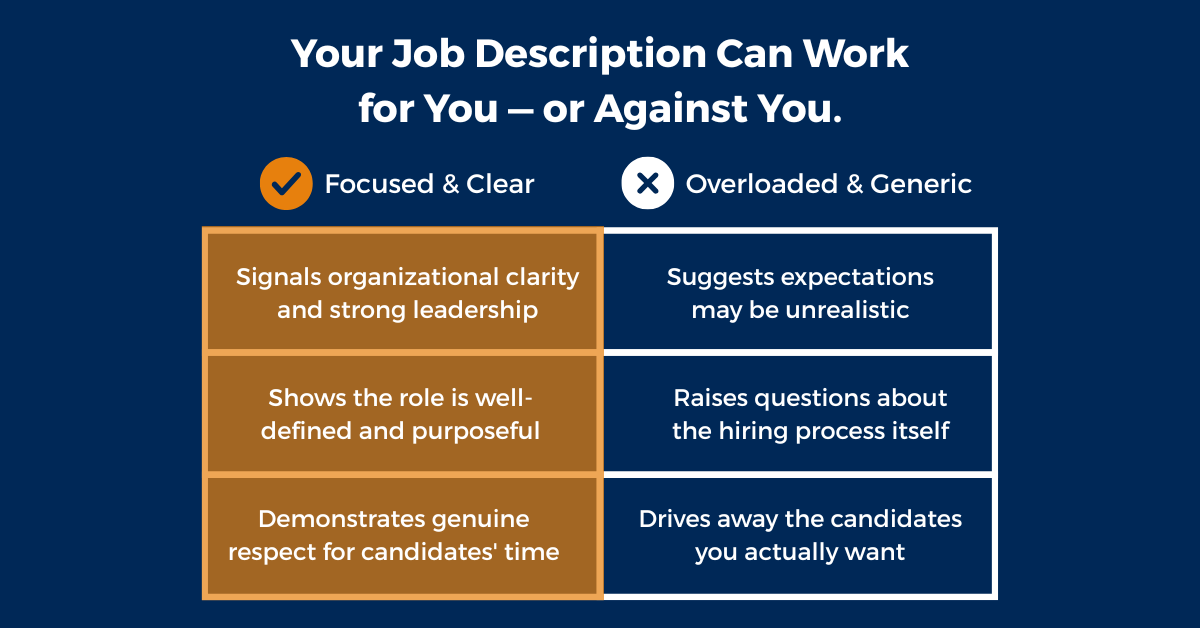
The good news is that this works in your favor when you get it right. A well-crafted job description doesn’t just attract more applicants — it attracts the right applicants, builds confidence in your company before the first conversation, and contributes to a reputation as an employer that people genuinely want to work for. That reputation compounds over time, and it becomes one of the most valuable and underrated advantages a company can have in a competitive talent market.
💡Tip: A strong job description gets the right candidates in the door — but how your team shows up once they arrive matters just as much. Read our blog For Employers: Why Interview Preparation Matters for practical guidance on making the most of every conversation with top talent.
Summary
A job description that stands out in a competitive job market isn’t about being clever or loading it with the right keywords — it’s about being clear, honest, and focused on what actually matters. Highlight the qualifications and skills that are truly essential, distinguish them from the ones that are simply helpful, describe what success looks like in the role rather than just listing duties, and give candidates a genuine sense of your company culture and what makes the opportunity worth pursuing.
Done well, a strong job description does more than attract applicants — it attracts the right applicants, filters out mismatches early, supports legal compliance, and sets the stage for a hiring process that’s more efficient and more likely to end with the right hire. It also positions your company well in a job market where industry professionals and qualified candidates have plenty of options and are looking for a reason to choose yours.
Ready to Make Your Next Great Hire?
At Murray Resources, we’ve spent over 30 years helping Houston’s leading employers attract and hire top talent — and we’d love to help you do the same. We’re proud to hold a 95% client satisfaction rate, have been named the #1 most awarded recruiting firm in Texas, and carry an A+ rating from the Better Business Bureau. Our clients have worked with us for an average of 11 years, and client referrals remain our largest source of new business — which we think says more about the work we do than anything else could.
If you’re looking for a recruiting partner who understands what it takes to stand out in a competitive market, we’d love to connect.
📌 Hire a Candidate — let’s find the right person for your team.
📌 What We Do — learn more about how Murray Resources supports your hiring needs.
📌 Contact Us or call us directly at 713.935.0009 — we’re happy to talk through how we can help.
Q&A
Q: How long should a job description be?
A: Most effective job descriptions fall between 300 and 600 words — long enough to communicate what matters, short enough to keep a candidate’s attention. Use bullet points to break up key information and make the position easy to scan. If you find yourself writing more than that, it’s usually a sign that the job description is trying to do too much — and that some of what’s in it, including vague references to other duties or filler language, could be cut without losing anything important. The goal is a focused, readable posting that opens doors to the right conversations rather than overwhelming candidates before they’ve even applied.
Q: How many requirements should we list?
A: Fewer than you think. Most positions have three to five genuinely non-negotiable qualifications — the skills, work experience, and education someone truly needs to succeed from day one. Everything beyond that is either a nice-to-have or something that can be gained on the job over time. The more requirements you list, the more candidates will self-select out — including strong ones who assume they’re not the right fit simply because the list feels overwhelming. A long list of qualifications rarely helps you find better candidates — it usually just reduces the number who apply and limits the many opportunities you have to connect with genuinely talented people.
Q: Should we include salary information in our job descriptions?
A: Yes — and not just because it’s becoming legally required in more states. Candidates who know upfront whether a role aligns with their salary expectations are more likely to apply if it does, and less likely to waste everyone’s time if it doesn’t. Salary transparency also signals respect for job seekers’ time, builds confidence in your organization, and gives your posting a competitive edge in a job market where many companies still don’t disclose compensation. Details like flexible hours and key benefits are worth including too — they’re a meaningful part of your personal brand as an employer and often make the difference between a strong candidate pursuing your job opportunity or moving on to the next one. If you’re not comfortable with a specific number, a range is far better than nothing.
Q: What legal compliance considerations should we keep in mind when writing job descriptions?
A: Every job description should reflect equal opportunity employment practices and be reviewed for language that could inadvertently exclude protected groups. This includes being mindful of the Americans with Disabilities Act when describing physical requirements or essential functions, avoiding language that implies age, gender, or other protected characteristics as preferences, and making sure the posting accurately reflects what the role requires rather than creating unnecessarily restrictive barriers to entry. It’s also worth making sure that other duties are described in a way that’s honest and realistic — candidates who feel misled about the scope of a position after they’ve accepted an offer rarely stay long. If you’re not sure whether your job description is compliant, having it reviewed by HR or legal counsel — or by an experienced recruiting partner — before it goes live is always a smart step.
Q: How often should we update our job descriptions?
A: Every time you post a role — not just when you create a new one. The job market, your company’s needs, and the competitive landscape for talent all develop and change over time, and a job description that worked well two years ago may not stand out as effectively today. Before posting any role, stay active in researching the current market, review the job description with fresh eyes, and ask yourself whether it still accurately reflects the position, the essential functions, and what makes the job opportunity worth pursuing. A job description that feels current and intentional is one of the simplest ways to signal to candidates that your company is too.
Q: What thoughtful questions should we be asking when evaluating our job descriptions?
A: This is one of the most underrated parts of the process — and asking the right questions before a job description goes live can save a lot of time and effort on the back end. Some of the most useful ones to consider: Does this job description accurately reflect what someone will actually be doing in this position — including any other duties that come with the role? Are we being honest about the skills and experience required, or are we padding the list? Does the posting give candidates enough context to update their resume thoughtfully and apply with confidence? Would a strong candidate reading this feel excited about the job opportunity — or would they move on because it doesn’t open doors to what they’re looking for? Does the description reflect our actual culture, or a version of it we think candidates want to hear? Taking the time to ask and honestly answer those questions before posting is one of the best investments a hiring team can make.
Q: How can recruiters help us improve our job descriptions?
A: Recruiters add real value well beyond just sourcing candidates — and refining job descriptions is one of the most practical ways a recruiting partner can help. At Murray Resources, we work with hiring managers and organizations to write job descriptions that attract the right candidates, communicate opportunities clearly, and reflect company culture and values accurately. We also bring knowledge of what’s working in the current job market — which skills and qualifications candidates are responding to, what soft skills employers are prioritizing, and how to position a role and its many opportunities so it stands out to the industry professionals you most want to reach. Whether you’re starting from scratch or looking to gain experience refining your existing process, get in touch — we’d love to help.